Sunday, February 21, 2021

Hybrid Ducks

This winter, I decided that I would put some extra effort into seeing and photographing hybrid ducks. The west end of Lake Ontario, including Hamilton Harbour, is a haven for winter ducks, so there are normally a few hybrids hanging around. I'm not sure if this was a particularly good year for hybrids showing themselves in common birding spots, but I managed to see a few, and some that are less common than others.

Redhead x Ring-necked Duck (02-Jan-2021)

My favourite of this winter's hybrids was a Redhead x Ring-necked Duck. One had been spotted by a couple of good birders at LaSalle Marina, so I went looking for it. After striking out a couple of times to find this bird, I had some extraordinarily good luck on the third time trying to find it. It was a very calm morning and a small raft of Redheads was sleeping quite close to shore right in front of one of my favourite spots for photographing ducks. After looking closely at each sleeping Redhead, I eventually came across one whose head was closer to purple-brown than the usual bold cinnamon-red of a Redhead. 

Hybrid REDH x RNDU sleeping with Redheads.
Note the difference in head colour and plumage.

REDH x RNDU keeping an eye on me while it tries to sleep.

It slept for almost the entire hour and a half I watched it, expect for about 30 seconds when I raised its head. As you can imagine, I snapped away like a madman when this happened!
Redhead x Ring-necked Duck hybrid: That is one gorgeous duck!

Redhead x Ring-necked Duck hybrid: That is one gorgeous duck!

Redhead x Ring-necked Duck hybrid: That is one gorgeous duck!

Redhead x Ring-necked Duck hybrid: That is one gorgeous duck!

Redhead x Canvasback (31-Dec-2020)
Scoring a close second in terms of my favourite looking hybrids this winter is this Redhead x Canvasback hybrid. Joanne Redwood has been reporting this duck for a couple of weeks by the time I actually found it. After many failed trips to LaSalle looking for it, I was walking along the shoreline path when I spotted a small group of 6 Canvasback ducks up ahead. I didn't have a great view of them through bushes and branches, but something made we look closely at them. I quietly walked out onto the rocks and positioned myself for when the ducks might swim right in front of me. As I waited, I was able to confirm that the REDHxCANV was indeed in the group that was swimming my way.

A lot of the markings on this duck make it look like a Redhead, until you notice the slope and size of the bill and that deep orange eye.

Redhead x Canvasback Hybird

Redhead x Canvasback Hybird with female Canvasback in front for comparison.

Redhead x Canvasback Hybird


Brewer's Duck: Mallard x Gadwall Hybrid (10-Jan-2021)

I've been waiting to see a Brewer's Duck! I thought I had one last winter, but it turned into a Mallard x American Black Duck hybrid. We didn't have the closest view of this hybrid duck, but I was happy to see it and get some record shots.

Brewer's Duck (Mallard x Gadwall hybrid)

Brewer's Duck (Mallard x Gadwall hybrid) with Canada Goose

Mallard x American Black Duck Hybrid (02-Jan-2021)
Mallard's seem to be very indiscriminate in their mating habits! Mallard x Black Duck hybrids are not exactly rare, but they're still interesting to see.
Mallard x American Black Duck hybrid

Common Goldeneye x Hooded Merganser Hybrid (20-Dec-2020)
Perhaps the most interesting hybrid I've seen this winter was this Common Goldeneye x Hooded Merganser. I didn't get particularly close views if this bird, but I dd manage a couple of record shots. I'll be on the look-out for better photos of this kind of hybrid in the future.
Common Goldeneye x Hooded Merganser hybrid


Blue Bills without Blue Bills ... yet

Birding opportunities are infrequent these days. In addition to my job being very busy, Ontario's in a COVID lockdown. Needless to say, my looks at birds have been mainly limited to my backyard feeder. But I did have a one-hour visit at LaSalle Marina one morning in early February, just as we were finally starting to get cold winter temperatures. (December and January were very mild this year.) There are usually a few open patches of water at LaSalle in winter, and I was hoping there would be the morning I went looking for Ruddy Ducks.

I went to one of my usual spots at LaSalle and, sure enough, there was an open patch of water right along the shoreline. Unfortunately,  there were only a few Mallards and Common Goldeneyes swimming in it. As I walked closer, though, a flurry of duck noise erupted as a flock of Ruddy Ducks launched from a spot I couldn't see further down the shoreline. I watched the flock fly around in circles as they looked for an open-water landing zone, hoping they'd find the patch right in front of me. After a few swirls around the area, they started coming down lower and aiming for my patch of water. As I carefully and quietly climbed over some rocks to position myself lower and closer, they started landing. Too bad I wasn't already in position or else I would have tried for some landing shots.

For the next hour, I had a flock of between 30 and 40 Ruddy Ducks in a relatively small space right along the shoreline. It didn't take too long for them to become comfortable with me sitting quietly on a (very cold) rock only 20 or 30 feet away from them. The lighting was not what I'd call awesome, with there being a mix of cool shade and harsh bright sun. But I'd never had Ruddy Ducks so close before, so I took advantage of the situation and fired off lots of photos.

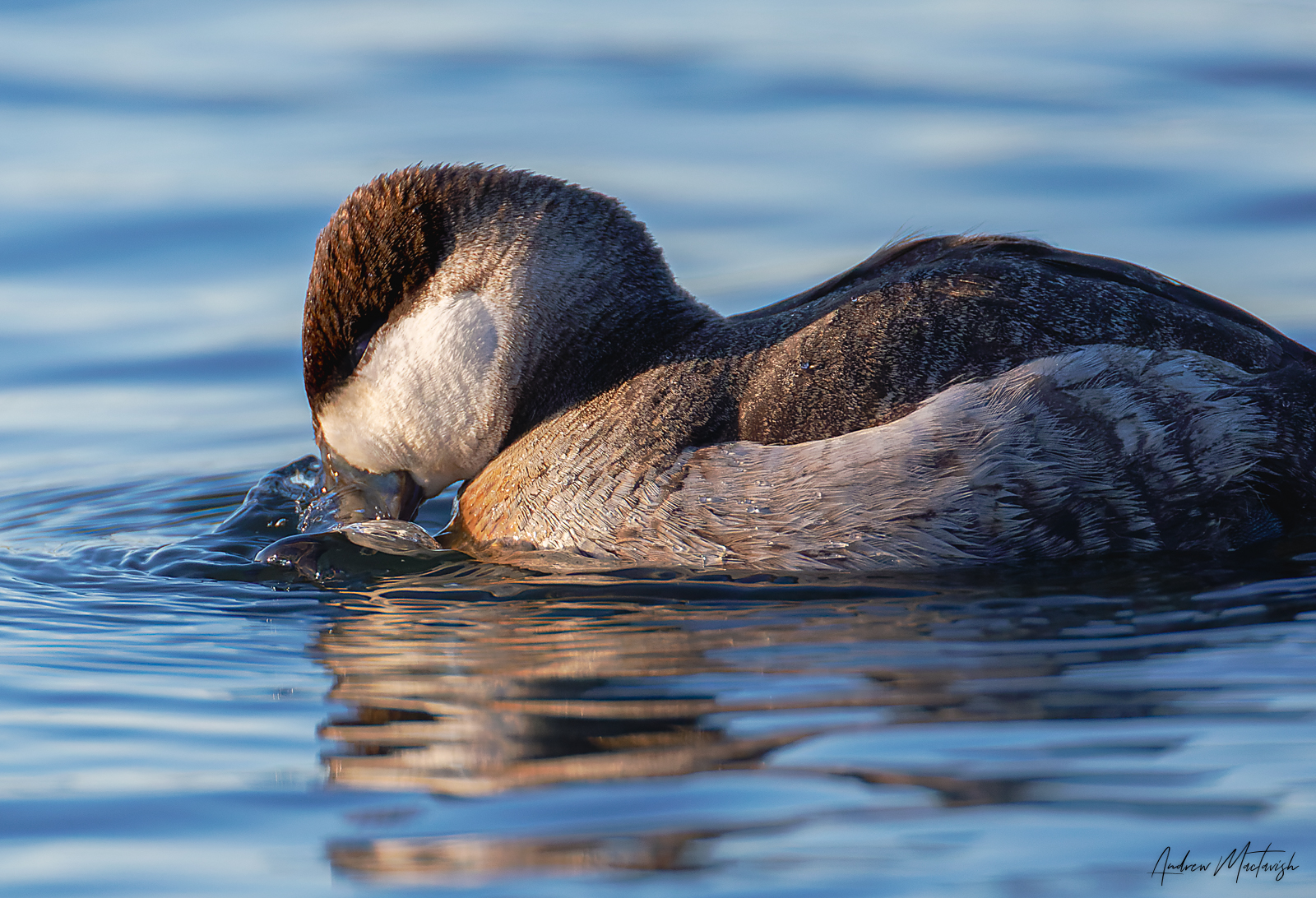
Perhaps the most interesting part of this experience was seeing drakes in various stages of transition into breeding plumage. Yes, it would have fantastic if they were in their full, blue-billed breeding plumages, but I'm happy to photograph birds in all of their plumages. Here are some of the photos from that day:

Searching for Open Water:

Ruddy Ducks: Part of the flock circling open water

Drakes Transitioning: Bodies Showing Chestnut

This drake was the most chestnut-coloured of the flock.
Drake Ruddy Duck in Transition

Drakes Transitioning: Bills Turning Blue

Drake Ruddy Duck in Transition: Blue bill starting to show

Drake Ruddy Duck in Transition: Blue bill starting to show

Drake Ruddy Duck in Transition: Blue bill starting to show

Drake Ruddy Duck in Transition: Blue bill starting to show

Practicing Bubbling Blowing Courtship Display?
Is this drake practicing its bubble blowing courtship display?

Immature Males
Probably a first-year drake

Probably a first-year drake

Probably a first-year drake


Sunday, January 31, 2021

Common Redpolls

It's been a great year for winter finches in many parts of Canada, including the southern half of Ontario where I live. Reports of Evening Grosbeaks, Pine Grosbeaks, Bohemian Waxwings, White-winged Crossbills, Red Crossbills, and Common and Hoary Redpolls are as common as Mallards at the local park pond. There's also been a significant increase in the number of Red-breasted Nuthatches over last winter. So far, I've managed to see one flock of EVGR fly overhead, one female Pine Grosbeak closeup and a small flock overhead, a few flocks of White-winged Crossbills, lots of Red-breasted Nuthatches, and many, many Common Redpolls plus a few Hoary Redpolls. I'm continuing to hold out hope for close views of Evening Grosbeaks and Bohemian Waxwings.

I can't think of a better winter for this invasion from the north. Seeing splashes of colour and high-energy birds feeding has been a treat to distract many of us from the darker, more depressing parts of life these days.


On January 10, I had awesome photography experiences with a flock of 200+ Common Redpolls (CORE). The flock seemed to grow to 300+ by the time I saw them again two weeks later. This flock had been reported for a week or so before I saw them and some very well respected birders had identified a couple of Hoary Redpolls in the flock, so I went to have a look.

As I walked the pathway beside a fallow field, I could see the flock moving around along the tops of the tall weeds. "Awesome," I thought as I watched the flock and noticed that the sun was in the perfect spot for photos. In the past weeks, I'd been trying mainly for close shots of individuals, but the conditions today looked good for flock shots. I enjoy photos of individual Redpolls, especially close shots showing the feather patterns, but most of the time I see CORE, they're in fast-moving flocks as they fly from feeding spot to feeding spot. I wanted to try to photograph this behaviour if I could.

My attempts to photograph the flying flock were pretty close to disastrous. My camera was unable to focus on the very quickly moving swarm of birds that sometimes came with a few feet of my head. I was shooting with my 600mm + 1.4x, so I wonder if I would have had better luck with less lens, such as the 100-400mm. I managed one or two photos that are acceptable, but I wasn't getting what I wanted.

Eventually, the flock began to land in the tops of weeds close enough to the path to get good photos. The challenge now was how to get groups of birds in focus without obstructions as they fed on the seeds. I had to work quickly since they would frequently all fly off. Thankfully, they often came back after a few circles around parts of the field.

My technique here was pretty simple and straight-forward: find a group of birds feeding together, focus on unobstructed birds in the front of the group, start shooting and hope for the best. I made sure my shutter speed was fast to freeze movement. Sometimes I adjusted the aperture for greater depth of field, but the birds were far enough away that depth of field wasn't a big issue. I alternated between f/8 and f/5.6. Interestingly, the narrower depth of field at f/5.6 produced some of the best shots creating nice blur (bokeh) in the background where other members of the flock were feeding.

I ended up with a lot of useless photos that quickly went into the dustbin (not unusual), but a few of them surprised me. Here are some of my favourites:

Feeding Flock

Common Redpolls Feeding:
Finding unobstructed views of a group was a challenge!

Common Redpolls Feeding:
One of my favourites showing behaviour - and they're all in focus!

Common Redpolls Feeding

Flock in Flight

Common Redpolls:
One of only a few flight shots of the flock in in flight

Common Redpolls:
Pure luck to be shooting rapid-fire when they suddenly flew

Common Redpolls:
Pure luck to be shooting rapid-fire when they suddenly flew

Singles

Common Redpolls are quite photogenic when down low in a field

Common Redpoll Balancing

Common Redpoll

Conclusion

It has certainly been a great winter for Common Redpolls in southern Ontario. I wonder when we'll have another winter as good as this one has been!

Until next time ...


Sunday, January 3, 2021

The Northern Pintail: A Duck Above the Rest

I love getting great photos of great birds. What constitutes a great photo will always be a topic of debate since "great photo" means different things to different people at different times.

The same can be said about what constitutes a great bird ... well, sort of. While my notion of a great bird photo is quite broad, my notion of a great bird is a little less flexible or wishy-washy. I can imagine a great photo of a Black-capped chickadee, but I cannot image a Black-capped Chickadee as a great bird. (I should say that I quite like Black-capped Chickadees. I often speak with them and enjoy inviting them to my outstretched hand for a quick hello. They are indelibly stamped in the background sites and sounds of life in my part of Canada, and they're mighty cute too.) All that being said, I would classify a Boreal Chickadee as a great bird in my area since they're almost never seen here. In my mind, a great bird is one that I rarely see or one that takes work to see. Those are the birds that I enjoy photographing the most.

Sometimes, though, there are birds that are so easy to see and photograph that they might be excluded from that definition of greatness, but they shouldn't be. Take the Northern Pintail (NOPI). It's a relatively common duck, although I don't see many in the places where I bird in the Hamilton Study Area, at least not in the numbers we're accustomed to when it comes to most of Ontario's other endemic duck species. It's common to see flocks of them fly overhead during migration, but less so to see them swimming in puddles and along the lakeshore. Maybe I need to visit local marshes more frequently. Luckily, for the past few winters, one drake NOPI has been visiting the beach area at LaSalle Marina in Burlington. It becomes an annual celebrity, attracting lots of lookers, normally with their cameras.

One reason it attracts so many birder photographers is that male NOPIs are incredibly good looking birds. Most written accounts of the Northern Pintail in birding books begin describing them with the adjectives "slender and elegant" in the first sentence. They are extremely photogenic birds, with beautiful plumage emphasizing beautiful shape. They're the kind of bird that photographs well in full body shots on land or on the water, with other ducks or alone, flying overhead in flocks or from very close range.

Over the last few years, I've taken photos of them from all of these perspectives. Here is a collection of some of my favourites. All photos were taken with a Canon 5DIV with either a 600mm f/4 + 1.4x extender or a 100-400mm f/4.5 - 5.6 + 1.4x extender. These lenses make it possible to get close shots without being so close as to disturb the bird.

Portraits

The NOPI at LaSalle is quite tame, so full-frame shots are possible without getting too close.

NOPI are long, so it can be fun challenge to make sure their pintail is in the frame! 

Looking bold as it walks onto the beach!

Beautiful patterns in those feathers!


Closeups

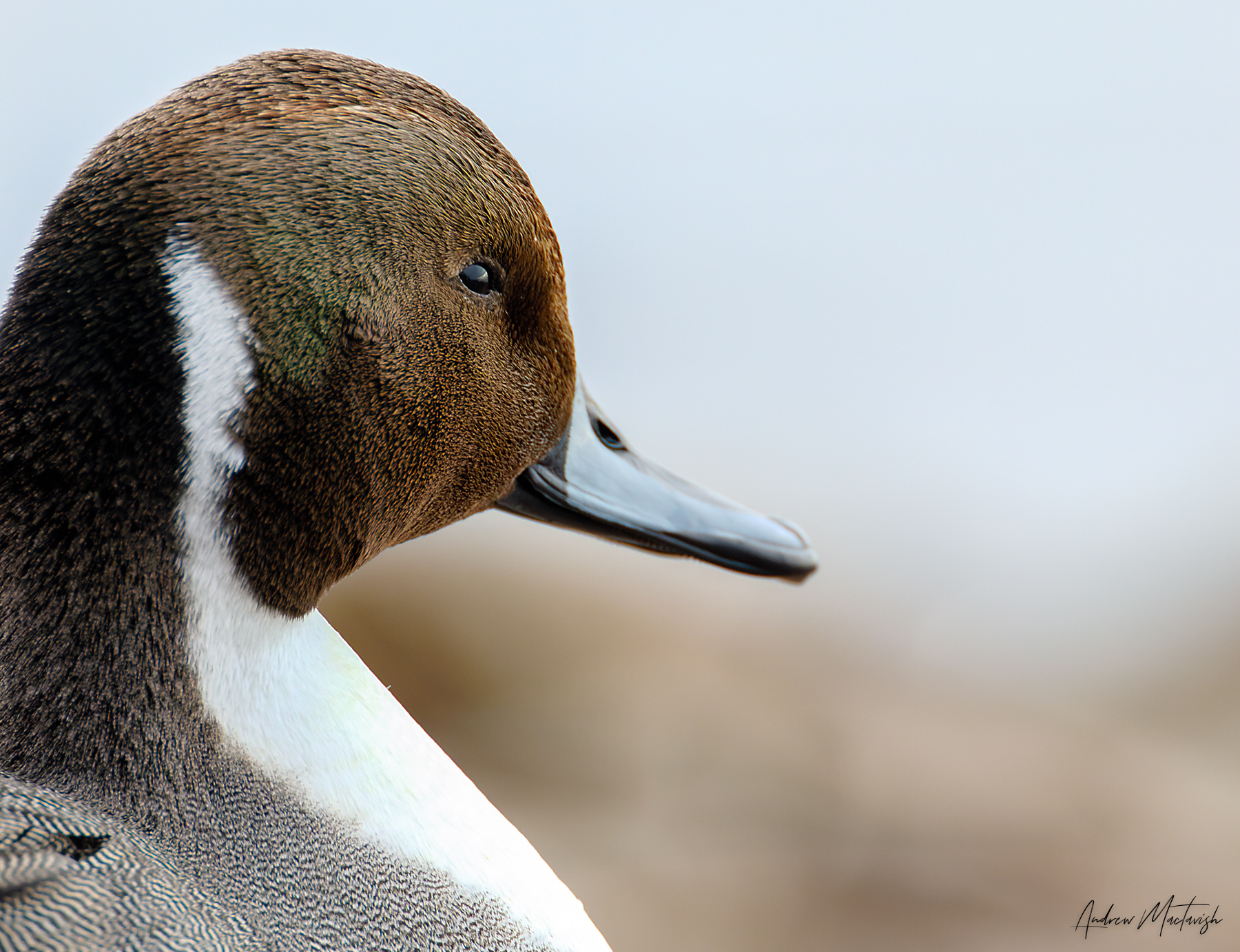
Elegance in the details

Shades of brown, green, and even pink in the head.

Contemplative NOPI?
Group shots
Elegance meets the rabble.

Got my ducks in a row.

In Flight
Flying with American Wigeon at Long Point.

Flying with American Wigeon at Long Point.

A flock migrating over Hamilton in early spring, 2020.

A Few More Looks
The curves!

The look!

Elegant shape!


Final Thoughts
Northern Pintail may be common, but they're uncommonly beautiful. You'll notice that all the photos here are of breeding plumage males. Well, that's because they're so much more striking than the females. 

Until next time ...