Monday, May 10, 2021

Spring 2021 Migration, Post #1: May 01 - 09

May 1 - May 9 was a cool week for cool birds ... cool in both senses of the word. Migration is still slow, running mainly in trickles rather than flows, and there hasn't been a single fallout day yet. I'm looking forward to those coming over the next couple of weeks. Yet, as tepid as migration has been, there have been some very cool birds that have dropped by Hamilton for a visit during the first 9 days of May: Clay-coloured Sparrow, White-eyed Vireo, Yellow-throated Vireo, Cerulean Warbler, Yellow-throated Warbler, Prairie Warbler, Blue-winged Warbler, and Brewster's Warbler. I dipped on the Golden-winged Warblers. It's hard to complain about that, even if the number of the usual suspects is low.

So let's start with May 1st:
The bird of the moment was a Cerulean Warbler that showed up at Dundurn Castle on April 28th. I haven't see many Cerulean Warblers, and often I need to take a long drive to find one. Well, this one was in my neighbourhood! The views were relatively good given that some trees had only small buds on them. The dark cloudy days made photography less than ideal, but the sun came out on its last day, when it also spent time much lower in the trees.

Cerulean Warbler:

Cerulean Warbler: With some green still showing, I figure this must be a first-year bird.

Cerulean Warbler on a sunny day!

Cerulean Warbler

May 2nd and 3rd were fairly slow, but we did find our FOY Swainson's Thrush at LaSalle Park and, when I got home, I found a White-Crowned Sparrow in my back yard. Over the following days, the number of WCSP grew to four and they hung around for over a week (there are still at least two eating nyjer seed in my back yard as I type this.)

Swainson's Thrush at LaSalle Park in Burlington

One of four White-crowned Sparrows in my back yard all of May, so far.

Clay-Coloured Sparrow and Yellow-throated Warbler:
May 04 was a good day. It started with a nearly tame Clay-coloured Sparrow in the entrance gardens to Bayfront Park. I was birding with Alvan Buckley, who heard it first. Finding it amongst the House Sparrows was easy-peasy, as they say.

A fine looking Clay-coloured Sparrow!

Clay-coloured Sparrow at Bayfront Park

Later that day, Joanne Redwood went looking for the Clay-coloured Sparrow. She didn't find it, but what she did find certainly made up for it: a YELLOW-THROATED WARBLER!!! The bird stayed high in the trees, and sometimes disappeared for a while, so snaps were tough. Record shots are sometimes good enough!
Yellow-throated Warbler: A life bird for me!

As if the Cerulean and Yellow-throated warblers weren't enough, the very next day a White-eyed Vireo was found at 40 Mile Creek. Getting one White-eyed Vireo in a year is good. I don't have a lot of good snaps of them, so off I drove to have a look at this one. A group of us were looking for about an our before someone found it. It then took about another 45 minutes for it to come down low enough and close enough for nice photos. By this time, most people had left, so it was just me and the WEVI.

White-eyed Vireo at 40 Mile Creek on May 05

One of my favourite warblers to see every spring and summer is the Blue-winged Warbler. We're fortunate to have breeding BWWAs in the Hamilton area, and finding them is relatively easy. After dipping on a Golden-winged Warbler in Ancaster, my pals and I went to another location to see what was around, including Blue-winged Warblers. As soon as we arrived, we heard a Prairie Warbler sing twice. I got my bins on it long enough to ID it visually, but then it flew and we were unable to relocate it. While this was a bummer, we were soon distracted by a Blue-winged Warbler, which moved around the trees, occasionally singing and sometimes foraging down low. I immediately noticed that it had yellow rather than white wing bars, a trait of a BWWA I saw in the same place last year.

I managed to get some very close photos of this beautiful bird. Note the yellow and gold wing bars. Speculation is that this is a Brewster's backcross, meaning that a Blue-winged and a Brewster's mated and ended up with this. A Brewster's is a hybrid between a Blue-winged and a Golden-winged warbler.
Blue-winged Warbler showing yellow-gold wing bars.

Blue-winged Warbler. 

Blue-winged Warbler feeding.

This is a second BWWA in the same area. It was also singing a lot. Note its white wing bars.

So, as if things couldn't get better, the very next day, on May 09, I was birding at Woodland Cemetery, feeling a bit down because of a lack of new migrant birds. I was photographing a Black-and-White Warbler when I heard the song of a Golden-winged Warbler. Goodbye Black-and-White, hello Golden-winged!!!

I found the Golden-winged in some beautiful flowering trees and began to photograph it whenever it came out in the open, which wasn't often. It wasn't until I got home that I noticed this bird did not have a black throat or a very well defined black eye mask. It was BREWSTER'S WARBLER rather than a Golden-winged Warbler. 

Brewster's Warbler: Note the lack of a black throat and the weak eye mask.

A hungry Brewster's Warbler

Fresh caterpillar for the Brewster's Warbler

The Black-and-White Warbler I was photographing when I heard the buzzy song of a GWWA.

When I got home to have a look at the Brewster's snaps, I saw a report that there was a Yellow-throated Vireo just metres from my house ... so off I went. A great bird to end the first week of May migration mania!

Yellow-throated Vireo
That's it for the first 9 days of May. Hopefully  I will have lots to report over the next week so, and hopefully I'll have the energy to report it!!

Happy birding!

Tuesday, April 13, 2021

Spring Arrivals: Wilson's Snipe and Rusty Blackbird

08-April-2021 

There are a few certain signs of spring in southern Ontario: longer days, warmer temperatures (usually), a crocus in my driveway, and the arrival of Wilson's Snipes in the wet fields along 5th Road E! I love the early morning sounds of Wilson's Snipes, especially when they're winnowing.

It's best to stay in your car when watching and listening to the Snipes here. The shoulder is narrow and drops steeply into the field. Thankfully, it's not a busy road. It can take time for the WISNs to work their way close enough to the road for good views and photos. A scope will give you excellent views, but even a 840mm lens needs the birds closer than they usually are, at least in my experience.

I've made two visits to these Snipe fields this year. During my first visit, the birds stayed quite far away, I think in part because there were some birders on the shoulder walking around their scopes. These birds are skittish!

Today, after I'd been there a half hour with the birds only a little closer than yesterday, I saw two men walking towards the three parked cars with lenses out of their windows. They yelled when they spoke, and one was singing/yelling "My oh my, what a lovely day!" I knew this would scare all the snipes further back in the field. Sure enough, as they got to the cars yelling their curiosity about the cameras, all the snipes flew. I missed getting any good flight shots!

Eventually, the birds started to fly back, but not before a flock of at least 6 Rusty Blackbirds showed up! It was great: lots of cool birds to focus on!

The following are some snaps from these visits:

Wilson's Snipe

Wilson's Snipe

A pair of Wilson's Snipe

A pair of Wilson's Snipe

A Killdeer and a Wilson's Snipe catch up after their long winter holidays south.

Some snaps of the Rusty Blackbirds:


The next weeks are going to be very busy with birding. I'm hoping I can write a few posts of spring migrants while it gets crazy fun!


Sunday, March 21, 2021

Yup, I Bought a Canon R5 Mirrorless Camera Body

Getting a new piece of photography gear is always accompanied by a mix of excitement and nervous anticipation. Will it be as good as I'm hoping? Was it worth the outlay? Please don't let me be disappointed! Then, after the first few weeks, things settle down and you just focus on taking good photos.

I bought a Canon R5 mirrorless camera body two weeks ago ... I'm still deeply in the stage of mixed excitement and nervous anxiety. I've taken it out a handful of times, often for only an hour or so at a time, but enough to develop some first impressions.

First Outing 

Our first outing together was to see some Tundra Swans that had landed in Hamilton Harbour hours earlier in the day. That afternoon, I ended work a little early to test out the camera in some of the record-setting high temperatures, and so I headed to the Waterfront Trail on the bay side of the York Blvd Bridge. It was a warm walk filled with those mixed emotions about how the camera would perform ... I'd only had it in my possession for three hours.

As I approached the bay, I could see some of the TUSW on the water, but soon my eyes gravitated left and they started putting together a huge raft of ducks! I saw Alvan Buckley, who had reported the TUSW and large numbers of migrating ducks earlier in the day, and I said, "Wow! Look at all the ducks!" He laughed with the kind of happiness that birders get in cool birding moments. He estimated that there were over 2000 ducks, including 350 American Wigeon, 300 Redhead, 100 Northern Pintail, and many Ring-necked, Gadwall, Northern Shoveler, Canvasback, Ruddy, etc. (See Alvan's ebird checklist here.) So, with all this waterfowl in front of me, I starting pressing the shutter!

A small slice of the very large raft of ducks, along with one Tundra Swan

Some of the American Wigeon stretching their wings.

Action shot of a TUSW

A pair of TUSW stretching their wings.

A group of Tundra Swans. There were 170 - 200 of them.

These were the first shots with the R5. I felt like a fish out of water, having to relearn where the dials were and then forgetting the simple basics of good photography. This was partly because of the strange adjustment to an electronic view finder. It was so foreign to look through, that I think it kind of blinded me to seeing the settings info. My cameras have always had optical view finders, but that's not an option on mirrorless cameras for the simple reason that they don't have mirrors!

I didn't really have any impressions after this waterfowl photoshoot. I liked some of the shots I got, although the keeper rate was pretty low, and I tested out the animal eye focus once or twice and could see how that was going to be fun to use!

The Real Testing Begins:

It wasn't until I sat down on a cloudy afternoon with some ducks that I had a chance to get comfortable with the new camera body. Most of the ducks from the waterfowl extravaganza a few days before had left, but some stayed. The north pond at Valley Inn had 34+ Gadwall, 16 Northern Shoveler, a couple of American Wigeon, and a smattering of other, more usual ducks. The next morning, the numbers of Gadwall had climbed a little to 40 or so (it jumped to 60 the next day). Both the afternoon and the morning photoshoots were fairly cloudy and dark, but this at least meant even light.

It was during these two times that I began to notice the slow and searching autofocus that a friend had told me about. Sometimes, the AF isn't able to focus on the subject when the contrast with the background is low, or at least I think that's the problem. I'd read about this online before buying the camera, but experiencing it was definitely more frustrating. I found myself compensating by pre-focusing on something closer when I could or by using the animal-eye autofocus to find the bird. These two techniques seemed to help, and they also helped me discovery a new technique made possible by having two autofocus buttons available at once (I use dual back-button focus - one with spot focus and the other with animal-eye focus). I could use the spot focus to get the bird in focus and then switch to animal-eye focus to reframe the image. This is similar to the focus-and-reframe shooting technique many use in one-shot drive mode.

Gadwall displaying (m) 

Gadwall (m) making it's quiet burping call.

Northern Shoveler (m). This bird was probably too far away to photograph with the 5DIV.

EDIT: Since writing that last paragraph, I've not had the same auto-focus issues with photographing ducks. Perhaps I've adjusted, just as I would have done when I first used my last camera body, the Canon 5DIV. The duck photography went very well, even though the ducks were far away, and much further than I would normally photograph with the 5DIV. The three photos above were probably out of the 5DIV's useable range. The larger sensor on the R5 (45MP vs 30MP) essentially adds extra reach, allowing for cropped photos with high levels of detail.

Flight shots are almost simple with the animal-eye focus, which takes a little of the fun out of the challenge!

Flight shots are a breeze with animal-eye focusing.

Testing with Little Birds: 

After those duck sessions, I decided to try some tests with little birds. My first experience using the R5 for little birds didn't go so well. In one instance, I was completely unable to focus on a Downey Woodpecker that was fairly close and more-or-less in the open, this after having a similarly tough time with a Song Sparrow that was amongst a lot of branches. The 5DIV would have snapped into focus without effort. This was quite disheartening!

Yesterday's experiments went a little better. I decided to check out a good spot for Eastern Bluebirds and Eastern Meadowlarks to see how things would go. The Bluebirds were a quick find. They stayed fairly far away, which I thought might be a good test for the camera. The Song Sparrow turned out to be the better test. It was closer, but still not frame-filling, and it was perched in a bush with lots of branches that could confuse a camera. Things went well. The best technique was to prefocus on something close and then focus on the bird.

The following photos of a Song Sparrow and two Eastern Bluebirds are not ones I'd use for anything other than auto-focus tests. The only editing has been to exposure, colour tone, and cropping. 

Song Sparrow in a bush #1:
This bird is almost too far away to crop and maintain detail. There was still lots of room to crop this tighter, but I wanted to show the mess of branches that could have confused the camera's auto-focus. Only exposure and colour tone have been adjusted and the photo was cropped. The bird is in focus.

Song Sparrow in a bush #2:
This bird was closer than the first SOSP. There was still lots of room to crop this tighter, but I wanted to show the mess of branches that could have confused the camera's auto-focus. Only exposure and colour tone have been adjusted and the photo was cropped. Ignore the overblown highlights in the bird's stomach. The bird is in focus.

These two Eastern Bluebirds were very far away. Focus is good.

With the mad rush of little birds on its way (all those warblers and vireos and thrushes and ... etc), I worry that the pre-focus technique will slow me down. I won't be putting the 5DIV away just yet. In fact, I plan to bring that body with me as a back up when warbler season arrives. Some shots ya just can't miss!!!

One interesting thing I've notice--this probably has to do with Canon's new CR3 RAW format--is that my editing workflow will need to change a little. I normally start in Lightroom, send out candidate files to DxO Photolab to sharpen and denoise, and then come back into Lightroom for exposure, colour tone, cropping, and fine-tuning to sharpening. Passing the file from Photolab back to Lightroom would result in a file that showed only a minor change to the white balance (each software company has its own RAW format, so there are inevitably slight changes introduced when converting between RAW formats). The change now, however, is dramatic, and it's not just white balance. It's exposure and colour tone too. The file needs to be edited differently than when I was using the 5DIV with the CR2 RAW format. I think this must be a DxO Photolab thing. Maybe DxO will build a fix for it.

So far, then, I'm getting warmer on the R5, but still not hot. Maybe things will get hot when the birding heats up in May!

One More:

One last photo before I go. This is a Pine Siskin that was at my feeders yesterday. In this photo, the bird is just far enough away to meet the minimum focal distance for my lens (somewhere around 13ft). The auto-focus did a bit of hunting before snapping into focus, but probably not much more than with the 5DIV.

Pine Siskin

Gear Used in the Blog Post:

  • Canon R5
  • Canon 600mm f/4 III
  • Canon 1.4x III extender
  • Canon Mount Adaptor EF-EOS-R (adapts EF lenses to RF mounts)
  • Duck photos were taken using a Gitzo tripod with Wimberley gimbal head


Sunday, February 21, 2021

Hybrid Ducks

This winter, I decided that I would put some extra effort into seeing and photographing hybrid ducks. The west end of Lake Ontario, including Hamilton Harbour, is a haven for winter ducks, so there are normally a few hybrids hanging around. I'm not sure if this was a particularly good year for hybrids showing themselves in common birding spots, but I managed to see a few, and some that are less common than others.

Redhead x Ring-necked Duck (02-Jan-2021)

My favourite of this winter's hybrids was a Redhead x Ring-necked Duck. One had been spotted by a couple of good birders at LaSalle Marina, so I went looking for it. After striking out a couple of times to find this bird, I had some extraordinarily good luck on the third time trying to find it. It was a very calm morning and a small raft of Redheads was sleeping quite close to shore right in front of one of my favourite spots for photographing ducks. After looking closely at each sleeping Redhead, I eventually came across one whose head was closer to purple-brown than the usual bold cinnamon-red of a Redhead. 

Hybrid REDH x RNDU sleeping with Redheads.
Note the difference in head colour and plumage.

REDH x RNDU keeping an eye on me while it tries to sleep.

It slept for almost the entire hour and a half I watched it, expect for about 30 seconds when I raised its head. As you can imagine, I snapped away like a madman when this happened!
Redhead x Ring-necked Duck hybrid: That is one gorgeous duck!

Redhead x Ring-necked Duck hybrid: That is one gorgeous duck!

Redhead x Ring-necked Duck hybrid: That is one gorgeous duck!

Redhead x Ring-necked Duck hybrid: That is one gorgeous duck!

Redhead x Canvasback (31-Dec-2020)
Scoring a close second in terms of my favourite looking hybrids this winter is this Redhead x Canvasback hybrid. Joanne Redwood has been reporting this duck for a couple of weeks by the time I actually found it. After many failed trips to LaSalle looking for it, I was walking along the shoreline path when I spotted a small group of 6 Canvasback ducks up ahead. I didn't have a great view of them through bushes and branches, but something made we look closely at them. I quietly walked out onto the rocks and positioned myself for when the ducks might swim right in front of me. As I waited, I was able to confirm that the REDHxCANV was indeed in the group that was swimming my way.

A lot of the markings on this duck make it look like a Redhead, until you notice the slope and size of the bill and that deep orange eye.

Redhead x Canvasback Hybird

Redhead x Canvasback Hybird with female Canvasback in front for comparison.

Redhead x Canvasback Hybird


Brewer's Duck: Mallard x Gadwall Hybrid (10-Jan-2021)

I've been waiting to see a Brewer's Duck! I thought I had one last winter, but it turned into a Mallard x American Black Duck hybrid. We didn't have the closest view of this hybrid duck, but I was happy to see it and get some record shots.

Brewer's Duck (Mallard x Gadwall hybrid)

Brewer's Duck (Mallard x Gadwall hybrid) with Canada Goose

Mallard x American Black Duck Hybrid (02-Jan-2021)
Mallard's seem to be very indiscriminate in their mating habits! Mallard x Black Duck hybrids are not exactly rare, but they're still interesting to see.
Mallard x American Black Duck hybrid

Common Goldeneye x Hooded Merganser Hybrid (20-Dec-2020)
Perhaps the most interesting hybrid I've seen this winter was this Common Goldeneye x Hooded Merganser. I didn't get particularly close views if this bird, but I dd manage a couple of record shots. I'll be on the look-out for better photos of this kind of hybrid in the future.
Common Goldeneye x Hooded Merganser hybrid


Blue Bills without Blue Bills ... yet

Birding opportunities are infrequent these days. In addition to my job being very busy, Ontario's in a COVID lockdown. Needless to say, my looks at birds have been mainly limited to my backyard feeder. But I did have a one-hour visit at LaSalle Marina one morning in early February, just as we were finally starting to get cold winter temperatures. (December and January were very mild this year.) There are usually a few open patches of water at LaSalle in winter, and I was hoping there would be the morning I went looking for Ruddy Ducks.

I went to one of my usual spots at LaSalle and, sure enough, there was an open patch of water right along the shoreline. Unfortunately,  there were only a few Mallards and Common Goldeneyes swimming in it. As I walked closer, though, a flurry of duck noise erupted as a flock of Ruddy Ducks launched from a spot I couldn't see further down the shoreline. I watched the flock fly around in circles as they looked for an open-water landing zone, hoping they'd find the patch right in front of me. After a few swirls around the area, they started coming down lower and aiming for my patch of water. As I carefully and quietly climbed over some rocks to position myself lower and closer, they started landing. Too bad I wasn't already in position or else I would have tried for some landing shots.

For the next hour, I had a flock of between 30 and 40 Ruddy Ducks in a relatively small space right along the shoreline. It didn't take too long for them to become comfortable with me sitting quietly on a (very cold) rock only 20 or 30 feet away from them. The lighting was not what I'd call awesome, with there being a mix of cool shade and harsh bright sun. But I'd never had Ruddy Ducks so close before, so I took advantage of the situation and fired off lots of photos.

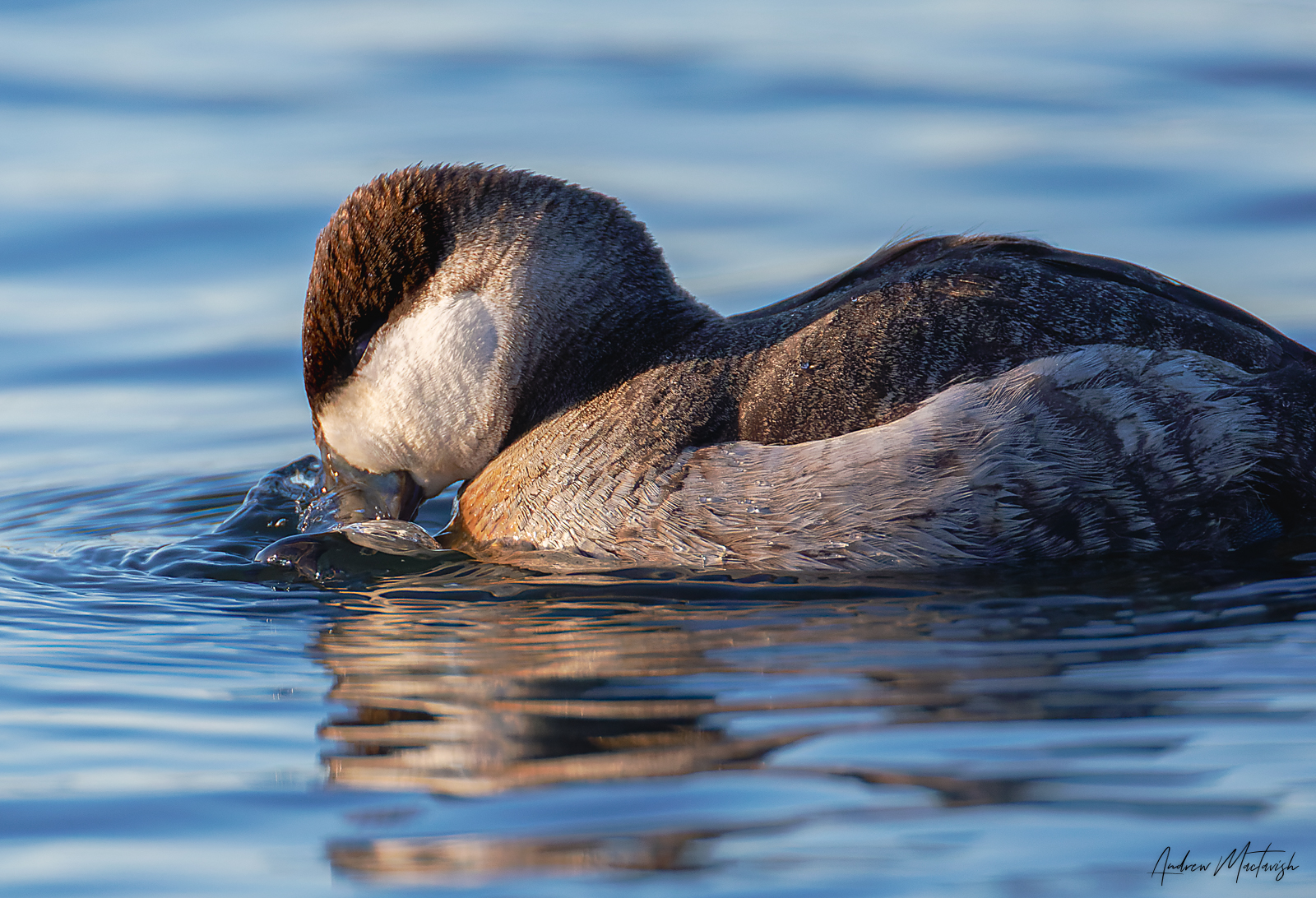
Perhaps the most interesting part of this experience was seeing drakes in various stages of transition into breeding plumage. Yes, it would have fantastic if they were in their full, blue-billed breeding plumages, but I'm happy to photograph birds in all of their plumages. Here are some of the photos from that day:

Searching for Open Water:

Ruddy Ducks: Part of the flock circling open water

Drakes Transitioning: Bodies Showing Chestnut

This drake was the most chestnut-coloured of the flock.
Drake Ruddy Duck in Transition

Drakes Transitioning: Bills Turning Blue

Drake Ruddy Duck in Transition: Blue bill starting to show

Drake Ruddy Duck in Transition: Blue bill starting to show

Drake Ruddy Duck in Transition: Blue bill starting to show

Drake Ruddy Duck in Transition: Blue bill starting to show

Practicing Bubbling Blowing Courtship Display?
Is this drake practicing its bubble blowing courtship display?

Immature Males
Probably a first-year drake

Probably a first-year drake

Probably a first-year drake