Sunday, January 3, 2021

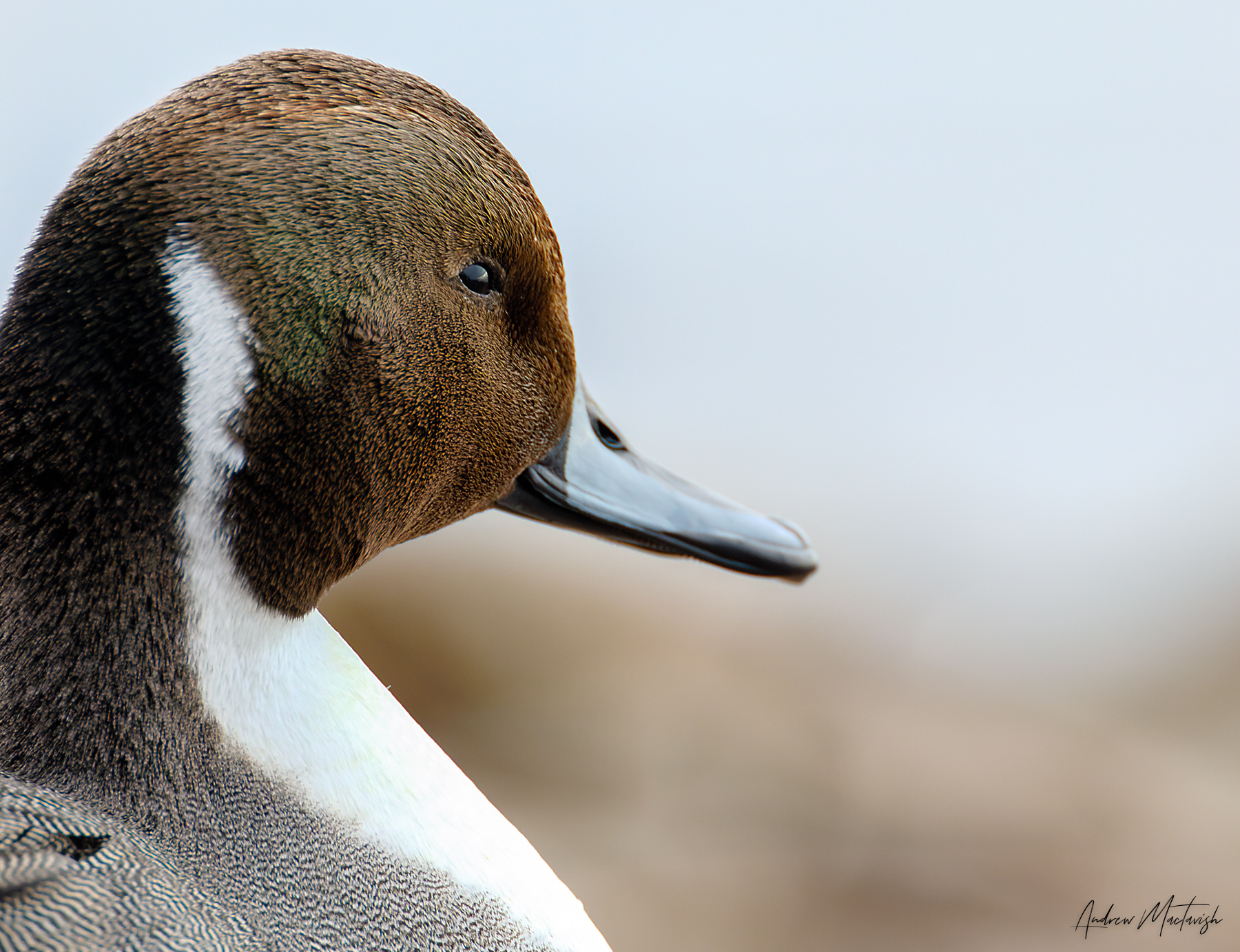
The Northern Pintail: A Duck Above the Rest

I love getting great photos of great birds. What constitutes a great photo will always be a topic of debate since "great photo" means different things to different people at different times.

The same can be said about what constitutes a great bird ... well, sort of. While my notion of a great bird photo is quite broad, my notion of a great bird is a little less flexible or wishy-washy. I can imagine a great photo of a Black-capped chickadee, but I cannot image a Black-capped Chickadee as a great bird. (I should say that I quite like Black-capped Chickadees. I often speak with them and enjoy inviting them to my outstretched hand for a quick hello. They are indelibly stamped in the background sites and sounds of life in my part of Canada, and they're mighty cute too.) All that being said, I would classify a Boreal Chickadee as a great bird in my area since they're almost never seen here. In my mind, a great bird is one that I rarely see or one that takes work to see. Those are the birds that I enjoy photographing the most.

Sometimes, though, there are birds that are so easy to see and photograph that they might be excluded from that definition of greatness, but they shouldn't be. Take the Northern Pintail (NOPI). It's a relatively common duck, although I don't see many in the places where I bird in the Hamilton Study Area, at least not in the numbers we're accustomed to when it comes to most of Ontario's other endemic duck species. It's common to see flocks of them fly overhead during migration, but less so to see them swimming in puddles and along the lakeshore. Maybe I need to visit local marshes more frequently. Luckily, for the past few winters, one drake NOPI has been visiting the beach area at LaSalle Marina in Burlington. It becomes an annual celebrity, attracting lots of lookers, normally with their cameras.

One reason it attracts so many birder photographers is that male NOPIs are incredibly good looking birds. Most written accounts of the Northern Pintail in birding books begin describing them with the adjectives "slender and elegant" in the first sentence. They are extremely photogenic birds, with beautiful plumage emphasizing beautiful shape. They're the kind of bird that photographs well in full body shots on land or on the water, with other ducks or alone, flying overhead in flocks or from very close range.

Over the last few years, I've taken photos of them from all of these perspectives. Here is a collection of some of my favourites. All photos were taken with a Canon 5DIV with either a 600mm f/4 + 1.4x extender or a 100-400mm f/4.5 - 5.6 + 1.4x extender. These lenses make it possible to get close shots without being so close as to disturb the bird.

Portraits

The NOPI at LaSalle is quite tame, so full-frame shots are possible without getting too close.

NOPI are long, so it can be fun challenge to make sure their pintail is in the frame! 

Looking bold as it walks onto the beach!

Beautiful patterns in those feathers!


Closeups

Elegance in the details

Shades of brown, green, and even pink in the head.

Contemplative NOPI?
Group shots
Elegance meets the rabble.

Got my ducks in a row.

In Flight
Flying with American Wigeon at Long Point.

Flying with American Wigeon at Long Point.

A flock migrating over Hamilton in early spring, 2020.

A Few More Looks
The curves!

The look!

Elegant shape!


Final Thoughts
Northern Pintail may be common, but they're uncommonly beautiful. You'll notice that all the photos here are of breeding plumage males. Well, that's because they're so much more striking than the females. 

Until next time ...


Monday, October 19, 2020

Editing and Over-editing Bird Photographs

It happens to the best of us at one time or another: we over-edit a bird photograph in our quest for the best, or maybe just to save an almost-good photo.

What do I mean by an "over-edited" bird photograph? Well, I mean any bird photograph where it's plain to see that the photograph has been edited well beyond what the photographer and camera actually saw. This can take many forms, but some of the more common over-edits I see daily on Facebook birding groups include: oversaturated colours, colour tone shifts, over-sharpening, object removal, and background replacements.

I should state right here that I'm talking about bird photographs that are presented as documentary photos, where fidelity to the visual elements of the species and its environment are important. There's wiggle room for some editing in documentary photos, especially when you consider that any RAW format photo needs to be edited (sharpness, colour, exposure), but also because lighting and colour cast can create photos that, even with only basic editing, show colour that doesn't match the species. So, if you photograph a bird in early morning light, you're going to get the effect of "golden hour" lighting, which might change the colour of the bird's plumage from what it "should" be under neutral lighting. Do you adjust colour temperature to match the bird with what it should look like? Or do you stay true to the moment and show what the bird did look like in that lighting? That's some of the wiggle room at play in editing documentary bird photographs.

In most of the Facebook birding groups I view, any photograph that's posted with only the species name and a description of when and where the photo was taken is making a claim to be a documentary photo. "This is a Blue-headed Vireo I photographed yesterday in my local birding patch." Most photos I view in FB birding groups make this sort of claim. Some will actually state what editing they performed or what special effect or filter they applied, but not many.

So, I'm not talking about photographs where the photographer intentionally pushes towards artistic presentation, where fidelity to the visual elements of the bird, its environment, and to the moment are far less important than visual effect. There's a spectrum between unedited and heavily edited bird photographs that would make for a very fine, and long, discussion. Here, though, I only want to focus on documentary bird photography and one common kind of over-editing.

Object Removal

The form of over-editing I want to focus on here is object removal, which is normally the removal of branches, leaves, sticks, and other items that make for a messy or busy background. This isn't quite the same as background replacement, but it is in the same same ballpark.

I will sometimes remove a branch or leaf that creates a distraction or prevents a really good photograph from being a great photograph. Most of the time, this is a branch that sticks out over an otherwise smooth area of bokeh or that comes too close to the bird and creates a distraction.

I try to keep this removal to a minimum for many reasons: the more I remove, the less true to the moment the photograph is; object removal takes time (well done object removal takes longer) and the results aren't always worth the effort; it's tempting and easy to go too far, especially with the incredible tools available in software like Photoshop; and if I remove something from one photo in a series, I might need to remove it from every other photo I use from that series, which multiplies the time it takes for editing. So, I try to keep this kind of heavy editing to a minimum.

Example #1
Below is an example of what I would consider minor object removal. A small snag on the perch branch created a minor distraction. Normally, I wouldn't have edited this out, but I wanted to create an example using a Blue-headed Vireo for this blog!

Before: Blue-headed Vireo with small snag touching the breast area.

After: Blue-headed Vireo with small snag removed.
Removing the small snag removes a small distraction. I don't think I need to remove it, but it does remove a small piece a clutter close to the bird. Others might have gone crazy smoothing out the background into a gradient of colour, but for me, that would remove any sense of environmental entanglement the background gives to this photo.

Example #2:
Here's another example of a relatively minor object removal, but one that I felt was more important to the overall photo. In the first photo, you can see an L-shaped branched in the top right corner. I didn't like that, so with some Photoshop magic, I removed it. I don't think the removal has much negative impact on the photo.

When the two photos are compared, it's possible to see the artefacts of my editing, but when you don't have the original to look at, it's much more difficult to know there was an edit.

Before: Blue-headed Vireo with distracting branch in top right corner.

After: Blue-headed Vireo with distracting branch removed.

Example #3
Here's an example of object removal that I think goes too far:

Before: Nice orange-green autumnal bokeh but branches create very busy background. 

After: Most of the branches have been removed, but it just doesn't look natural.

In the after image, the bird looks quite detached from the background (especially around the breast and head), almost as if it was a composite image. Perhaps a better edit would have helped, but the photo looks like I was more interested in the autumnal bokeh in the background than in the bird in the foreground. The background and foreground don't feel particularly well integrated to me.

I find this to be a very common error in judgement in the bird photography I see daily, even from some excellent photographers. Isolating the bird from its background becomes so important that all other environmental elements are removed, which can create a very unnatural appearance.

Conclusion:
That's it for this post. It's been a long time since I've posted anything here, but maybe that'll change now that the frenzy of fall migration is settling down.


Friday, April 10, 2020

Birding in the Pandemic: eBird, Surveillance, and this Silent Spring

As I write this, we are in the middle of the COVID-19 pandemic. Many countries around the globe have enforced at least some level of restriction on human movement and our proximity to others. Governmental response to the pandemic has resulted in one of the largest and most explicit expressions of body governance the modern world has known. We are experiencing a massive intensification of body governance that would make Michel Foucault turn in his grave!

Coupled with this new regime of hermetic bodies are the technologies of surveillance that we have willingly adopted into our daily lives. We all know that most of our online interactions are logged by the likes of Google, Apple, and the major telcos, and we know that these same companies continue to track our movements using GPS data from our mobile phones, even if they claim otherwise. Police forces and governments are now talking about using this GPS data to enforce quarantine and self-isolation orders. Sure, this can be justified as a means to "flattening the curve," but we really do need to be careful about what we wish for. It’s a slippery slope. As we learned in our post-911 world, temporarily giving up rights and freedoms often results in permanent restrictions written into law or simply accepted as okay in the name of security against terrorism, and now viruses. It remains to be seen which of the new restrictions on body movements will disappear, attenuate, or remain.

So what does this have to do with birding? A lot! Many of the parks and woodlands where birders go to view and record bird activity have been closed to the public. For birders, this couldn’t have happened at a worse time. It’s spring migration and billions of birds are on the move from their wintering grounds in the south to their breeding grounds in the north. Where I live, in Hamilton, Ontario, we are along one of North America's major bird migration flyways. Spring migration brings many species through the area that we only see during migration. It’s a beautiful, life-affirming spectacle, but it’s also so much more than that. It’s an opportunity to assess bird populations and their movements, including the dates of their migration and other data, all of which can tell us something about the impacts of environmental damage and climate change.

Most birders are enamoured by the beauty of birds and their behaviours, but many birders are also participants in what is probably the world’s largest example of organized citizen science. I’m talking about eBird, an application developed by the Cornell Lab of Ornithology. Many birders use eBird to record the birds they see, including when and where they see them. eBird collects bird data from millions of birders around the world and makes it freely available to anyone with an internet connection. It is a remarkably useful tool for gathering big data on bird populations and movements, and it serves as a useful tool for birders interested in locating and observing specific species.

One of the features of eBird is that it tracks when and where birds are reported, and this data is associated with the user’s name. Users have the option of being anonymous, but from my experience, most use their real names. Records are associated either with predefined hotspots or with the user's GPS coordinates. When you search eBird for hotspots or species, you are presented with a map of pins geographically representing records, which you can open up for the full record over decades of that predefined hotspot or user-defined place. eBird also collects the route someone has walked and how long it took them to walk it, although this is only viewable by the record-maker and, I assume, the Cornell Lab. This sounds a little like what Apple and others have done with mobile phone data, although eBird does it with the user’s knowledge and permission.

Ironically, eBird tracks the spatial and temporal movements of birders as much as it tracks this information about birds. Without much effort, anyone can see the when and the where of a birder’s birding records. Someday I’ll dig into the many meanings that we can find in this collection of an individual’s records, but for now I want to highlight what this could mean in a time of pandemic body governance.

Within less than a minute, I was able to see records of birders in parks and woodlands that have been closed to the public, although far fewer records than one would find under normal circumstances. Is it hubris to post these records, a belief that the individual's desires or citizen science outweighs the social benefits of restrictions during pandemic governance? I don’t have an answer for why, but I do find myself sensing a bright red flag for how this data could be used. If restrictions upon our movements increase (as they have been) and if penalties for breaking these restrictions are increasingly enforced (as we are beginning to see), then what is stopping authority from viewing these records as evidence of illegal activity? I suppose it depends upon how strongly the state will enforce its new rules, but it remains that posting records from areas with restricted access is a performance of disregard. For some, this is socially irresponsible; for others, this is commitment to citizen science.

One thing is clear. The usual avenues for reporting bird sightings are very quiet these days. Email listservs, messaging apps, and eBird itself are all nearly silent, and quite literally so for anyone accustomed to the regular “dings” of bird sighting notifications on their mobile phones. Ironically, it is a “silent spring,” to draw on Rachel Carson’s 1962 imagining of a world without birds. This “spring without voices” (Carson) is likely in part due to fewer people birding as regularly as they would under normal circumstances. But it is probably also due to people choosing not to report birds, whether to prevent a gathering of more than 5 people (rarities can bring crowds) or simply not to announce publicly that they’re birding. Is this a sign that birding is going clandestine? Maybe. Maybe it's a sign that some birders recognize the potential of social surveillance in their own surveillance of birds. Regardless, this is an eerily silent spring.


Saturday, March 21, 2020

Bring on Spring, Part 2: March 11 was Crazy Good!

The last two weeks have been a strange mix of great birds and deep angst. I'll save my thoughts about the COVID-19 pandemic and birding for another post and keep this post focused on the birds. This post is all about March 11, which was filled with excellent photographic opportunities for some spring migrants, including HOODED MERGANSER, RED-NECKED GREBE, GOLDEN EAGLE, and RED-SHOULDERED HAWK.

Hooded Merganser
Around this time of year, when the ice has melted and the ducks are active, the Valley Inn ponds can provide close views of some duck species. A small flock of HOODED MERGANSERs almost always finds its way here for a week or so every spring and fall. Normally, they are incredibly skittish and swim far away at the slightest sound or movement along the shore line. On March 11, I drove slowly beside one of the ponds and discovered a group of 6 feeding right beside the road. My lens was quickly resting on the bean bag for the car window!

Hooded Merganser eating a small fish
Eventually, the HOMEs swam out into the pond where the reflections from the hill side made for some great art shot opportunities.

Hooded Merganser
Hooded Merganser
Hooded Mergansers

Red-necked Grebe
This time of year, RED-NECKED GREBEs start returning to selected areas along the shores of Lake Ontario. A well-known spot for one pair is Bronte Harbour, where the town puts out floating tires for nesting spots. After finishing up with the Hooded Mergansers, I took a drive to Bronte Harbour to see if the RNGR were around. Sure enough, they were swimming in the harbour. I was hoping they would perform some of their mating ritual while I was there, but they didn't. They were, however, quite chatty with each other.

Red-necked Grebe
The other Red-necked Grebe
I had some very close views!

Golden Eagle
After arriving home from the Red-necked Grebes, I received a report that some Red-shouldered Hawks were migrating over the Hamilton area. So, off I went to the Valley Inn and Woodland Cemetery to see if I could find some. These moments are always fun when other birders are showing up for the same thing.

Our first stop was Woodland Cemetery, which has a few spots that provide good views south, east and west for migrating raptors. From here, we saw one distant Red-shouldered Hawk. As we were about to leave here and go to Valley Inn, we spotted a large raptor flying directly towards us. We could tell that it was an eagle, and I assumed it would be an immature Bald Eagle since we see so many of them at this spot. I started taking photos as it approached, thinking that it might not be a Bald Eagle ... maybe it's a Golden Eagle. It was cloudy and quite dark, so it was impossible to see any plumage markings at all. I took a number of snaps as it passed overhead so that I could look at them later on my computer.

When we got down to the Valley Inn, another birder was there who had just seen a Golden Eagle. Say what!?!? Sure enough, the bird that flew over us was an adult Golden Eagle. I didn't get finely detailed photos, but they're good record shots. Here's one:

Golden Eagle over Woodbine Cemetery

Red-shouldered Hawks
Down at Valley Inn, we patiently waited for migrating raptors, hoping for some Red-shouldered Hawks. It didn't take too long for one to fly overhead. We had three adults here, for a total of four on the day. Again, the dark afternoon did not provide good light, so the best I could hope for were some solid record shots. Someday, I'll get awesome, detailed photos of a Red-shouldered Hawk!
Red-shouldered Hawk
Red-shouldered Hawk
You can see the Red-shoulder on this one.
 All-in-all, a good day for bird snaps!

Bring on Spring, Part 1 (March 01 - 07)

It's been a while since I've written a post, which must mean that I've been busy with spring birding. It's true, so I'm going to write two posts since there's so much to cover.

Yes, migration has begun! Lots of new birds in the area, which is a relief! I love photographing ducks, but even I was getting a little bored with the same ones.

I guess you could say that the beginning of Spring arrived on March 4 when thousands of TUNDRA SWANs migrated over Hamilton. After reading an early morning report that a large flock of Tundras was observed flying over the area, I looked out my backyard window ... sure enough, off in the distance I saw a flock flying west. I quickly grabbed my gear, hopped in the car, and went to Woodland Cemetery, which provides a good view of the sky. At first, a few flocks of a couple hundred flew overhead, but that quickly turned into a stream of flocks, one after the other. I estimate seeing around 1,000 between 9:30 and 10:30.

Tundra Swans flying over Hamilton, 04-Mar-2020

Blackbirds have been pouring in as well. The familiar (and sometimes irritating) sound of RED-WINGED BLACKBIRDs has erupted! COMMON GRACKLEs have also been showing up. I'm sure there are BROWN-HEADED COWBIRDs too, but I have seen any yet. Many folks don't like Grackles because they aren't particularly friendly to smaller birds and they make a mess at their feeders. I think they look pretty cool this time of year. Those electric yellow eyes, that iridescent colouring, and their furrowed brows give them a very dramatic look.

Common Grackle at a feeder, 06-Mar-2020

This time of year also brings vagrants, who belong somewhere else. The first big one for this spring was a WESTERN GREBE seen down in Niagara-on-the-Lake. On March 7, Paul Riss and I took a drive down to have a look. It was surprising how close this bird came to shore. This was an Ontario first for me. There were also some RED-THROATED LOONs showing very well. One even had a bit of its red throat starting to show.

An unusually cooperative Western Grebe, 07-Mar-2020
Western Grebe with Red-throated Loon, 07-Mar-2020
One of the 4 or 5 RTLOs for the day. This one is showing some red on its throat.

The next day, I took a trip down to Valley Inn to see if some Cackling Geese were still present. They weren't, so I took a drive up to Gates of Heaven Cemetery to see if anything was happening there. There certainly was something happening. When I arrived, I rolled down my window to hear an EASTERN MEADOWLARK singing!!! I quickly found it perched on the tallest little tree in the field. I didn't get any snaps of it until the next morning.

Eastern Meadowlark arrived 08-Mar-2020

Unfortunately, a photographer was in the middle of the field playing taped recordings of birds, which is a no-no in spring. Birds might think there are competitors for territory when folks play bird recordings in spring. This is a known nesting spot for Eastern Meadowlarks, so I look forward to keeping an eye on them in the coming months, and hope to see fledglings in summer.

The Northern Shrike was also showing well, and even better the next morning when it came very close to me as I hid in my car. It perched on a Bluebird box for a couple of minutes, which made me laugh to think what a Bluebird would think about that!

Northern Shrike: A strange welcoming party for the Eastern Bluebirds 
Northern Shrike in flight

Shortly after those photos, a couple of birders showed up looking for the Eastern Meadowlark. We got to talking about the Shrike, and the story that someone had found Northern Shrike feathers a few weeks ago, suggesting that the bird we'd been seeing since November had died and the one we were seeing today was a different bird. When I got home afterwards, I started to compare photos. Sure enough, the bird from earlier in winter had more brown on its forehead and cheeks. The one that's there now is pristine white and grey.

Northern Shrike in January: Note brown smudging on forehead, cheeks, and throat.
Lower mandible is also light-coloured. 

Northern Shrike in March: Much cleaner without brown smudging. Lower mandible is dark.


Tuesday, March 3, 2020

Week Summary: Feb. 22 - 28

Not much changing in the birding scene lately. Lots of ducks are still around, with some REDHEADS coming in close and the usual good numbers of other species. It's been a bit of an odd winter for ducks this year without there being much ice around. On fair-weather days, many venture well offshore, which they wouldn't be able to do during a "normal" winter when the Hamilton Harbour has more ice.

The highlight of the week was a good one though! Paul Riss and I drove down to Ruthven Park where there's a pair of TUFTED TITMICE, along with some EASTERN BLUEBIRDS and other regular winter species. A Tufted Titmouse makes me think of what would happen if a Black-capped Chickadee and a Northern Cardinal had a baby!

Unfortunately, most photos I took were at a bird feeder, which is not my favourite backdrop for bird photos, but you take what your given.


The one decent photo not at the bird feeder.

Redheads were the other highlight of the week. I watched a male and female pair for about an hour as they fed quite close to shore. A female Canvasback was sticking quite close to them the entire time I watched them. It was interesting to see the behaviour of these ducks as they fed. The male Redhead seemed to be the one who would lead his partner away from shore when they noticed my movement, but the female seemed to lead them back to the feeding area close to shore when she deemed it was safe. The Canvasback was less wary of me, but still followed the Redheads wherever they went.

I was hoping this Redhead pair would "get it on" but they didn't.

The male Redhead would periodically go into alert mode, with its
 neck stretched up for better viewing.

The female Redhead feeding.
The female Canvasback would shake off after each dive for food.
This made timing photographs easier.
Early migration will begin to heat up a bit in the next week or so. Some RED-WINGED BLACKBIRDS are already coming in. Soon, we'll be seeing/hearing Killdeer and seeing Turkey Vultures.